
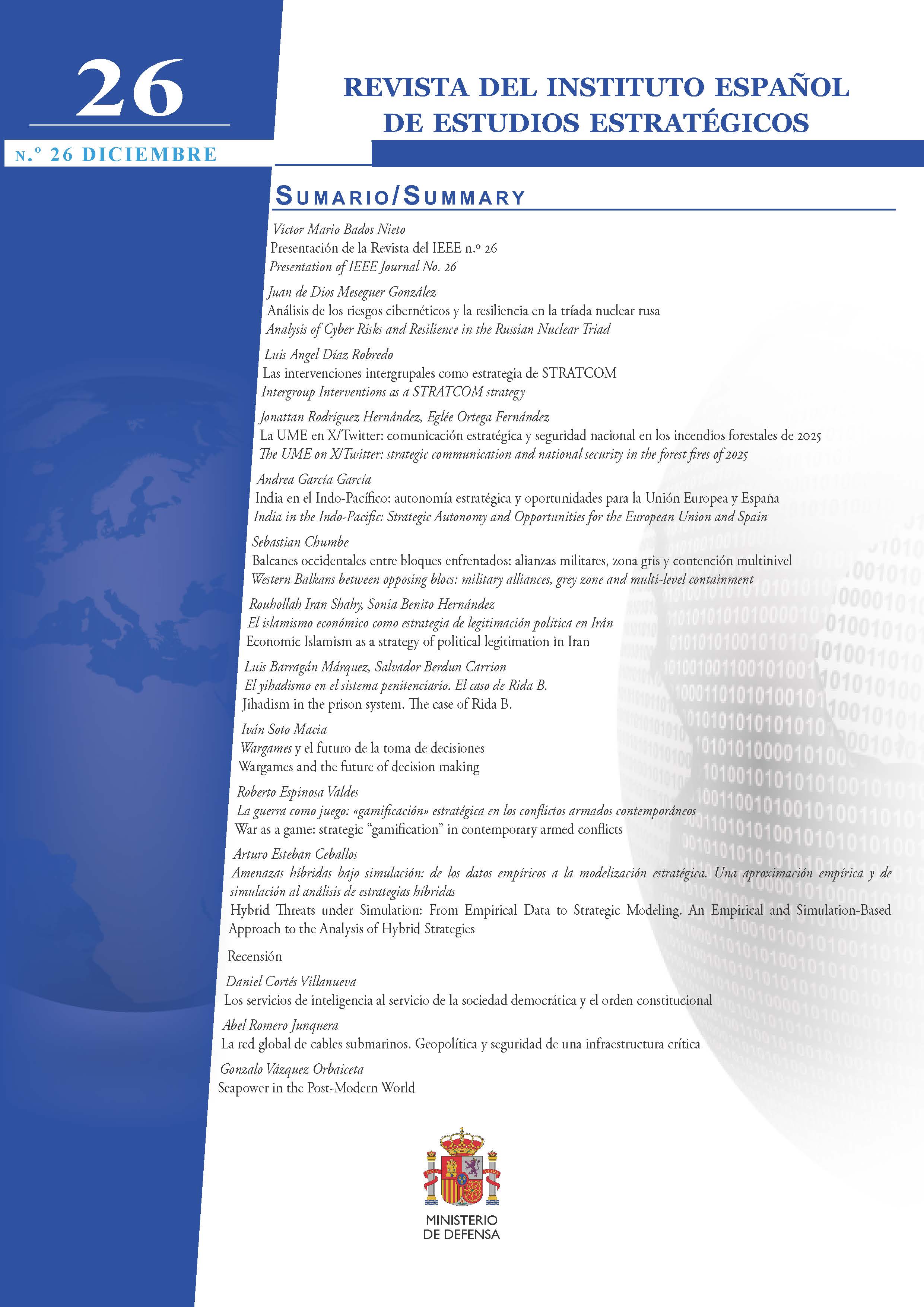
Hybrid Threats under Simulation: From Empirical Data to Strategic Modeling
Keywords:
hybrid strategies, DIMEFL, ABM-RL, GDELT, Turkey, Russia, Turkey, Nagorno-Karabakh, Influence, Armenia, Azerbaijan, SyriaAbstract
Hybrid strategies have become a central concern in contemporary strategic analysis, yet their systematic modeling remains limited. This article proposes a replicable methodology that integrates empirical analysis, formal classification, statistical modeling, and adaptive simulation. Drawing on the reclassification of events from the GDELT database into the DIMEFL scheme (Diplomatic, Informational, Military, Economic, Financial, and Legal), a quarterly panel of Turkish activity in Libya, Somalia, Mali, and Niger was constructed. This panel was analyzed through first-order Markov chains, negative binomial regression, and SARIMAX models, enabling the identification of sequential patterns and long-term trends. Complementing this approach, an agent-based model with reinforcement learning (ABM-RL) was developed, simulating Turkey as a strategic actor seeking to maximize influence while minimizing reputational costs. The simulation reproduced observed tactical sequences and uncovered adaptive logics that are less evident in empirical data alone. Although cognitive processes were not incorporated, cyber-physical-social systems are identified as a promising extension for future research. The proposed architecture constitutes a scalable framework for the study of hybrid threats and provides a robust foundation for the development of early-warning systems in multidomain environments.
References
Arslan, S. (2025). Measuring the impact of hybrid warfare and gray zone strategies on Turkey’s Middle East policy: 1991–2024 [en línea]. International Journal of Advanced Research. 13(10), pp. 1041-1058. [Consulta: 2026]. Doi: 10.21474/IJAR01/21995.
Baqués, J. (2021). DIME… espejito, espejito… si soy la más guapa del reino: análisis de los instrumentos de poder en el mundo actual [en línea]. Global Strategy Report. 29. [Consulta: 2026]. Disponible en: https://global-strategy.org/analisis-dime
Box, G. E. P. et al. (2016). Time series analysis: Forecasting and control. 5.ª ed. Hoboken: Wiley. ISBN 9781118675021.
Butler, D. y Gumrukcu, T. (2019). Turkey signs maritime boundaries deal with Libya amid exploration row [en línea]. Reuters. [Consulta: 2026]. Disponible en: https://www.reuters.com/article/world/turkey-signs-maritime-boundaries-deal-with-libya-amid-exploration-row-idUSKBN1Y21VL/
Cameron, A. C. y Trivedi, P. K. (2013). Regression analysis of count data [en línea]. 2.ª ed. Cambridge: Cambridge University Press. [Consulta: 2026]. Doi: 10.1017/CBO9780511814365
Chivvis, C. S. (2017). Understanding Russian “Hybrid Warfare” and what can be done about it [en línea]. Santa Monica (CA): RAND Corporation. [Consulta: 2026]. Disponible en: https://www.rand.org/content/dam/rand/pubs/testimonies/CT400/CT468/RAND_CT468.pdf
Deffuant, G. et al. (2000). Mixing beliefs among interacting agents [en línea]. Advances in Complex Systems. 3(1-4), pp. 87-98. [Consulta: 2026]. Doi: 10.1142/S0219525900000078
Degroot, M. H. (1974). Reaching a consensus [en línea]. Journal of the American Statistical Association. 69(345), pp. 118-121. Doi: 10.1080/01621459.1974.10480137
Denizeau, A. (2021). Mavi Vatan, the “Blue Homeland” [en línea]. Rabat: Policy Center for the New South. [Consulta: 2026]. Disponible en: https://policycenter.ma/publications/mavi-vatan-blue-homeland
Epstein, J. M. (2002). Modeling civil violence: An agent-based computational approach [en línea]. Proceedings of the National Academy of Sciences. 99(Suppl. 3), pp. 7243-7250. [Consulta: 2026]. Doi: 10.1073/pnas.092080199
—. 2006. Generative social science: Studies in agent-based computational modeling [en línea]. Princeton: Princeton University Press. [Consulta: 2026]. Disponible en: https://www.jstor.org/stable/j.ctt7rxj1
European Commission. (2016). Joint framework on countering hybrid threats—A European Union response (JOIN(2016) 18 final) [en línea]. EUR-Lex.
[Consulta: 2026]. Disponible en: https://eur-lex.europa.eu/legal-content/EN/TXT/?uri=celex:52016JC0018
Galeotti, M. (2016). Hybrid war or gibridnaya voina? Getting Russia’s non-linear military challenge right Mayak Intelligence / Lulu Press. ISBN 1365549801, 9781365549809
Gdelt Project. (2015). GDELT event database – Data format codebook v2.0 [en línea]. [Consulta: 2026]. Disponible en: https://data.gdeltproject.org/documentation/GDELT-Event_Codebook-V2.0.pdf
Gerasimov, V. (2016). The value of science is in the foresight: New challenges demand rethinking the forms and methods of carrying out combat operations [en línea]. Military Review. [Consulta: 2026]. Disponible en: https://www.armyupress.army.mil/journals/military-review/archives/2016/january-february/gerasimov
Goldstein, J. (1992). A conflict-cooperation scale for WEIS events data [en línea]. Journal of Conflict Resolution. 36(2), pp. 369-385. [Consulta: 2026]. Doi: 10.1177/0022002792036002006
Greene, W. H. (2018). Econometric analysis. 8.ª ed. Harlow: Pearson. ISBN 9780134461366.
Gürdeniz, C. (2006). Mavi Vatan. En: Turkish Naval Thought [colección]. [s. l.]: [s. n.].
Hartley, D. S. III. (2020). An ontology of modern conflict: Including conventional combat and unconventional conflict [en línea]. Cham: Springer. [Consulta: 2026]. https://link.springer.com/book/10.1007/978-3-030-53214-7
Hai, J.; Hou, L. y Wang, Z. (2018). Military brain science: How to influence future wars [en línea]. Chinese Journal of Traumatology. 21(5), pp. 277-280. [Consulta: 2026]. https://doi.org/10.1016/j.cjtee.2018.01.006
Hegselmann, R. y Krause, U. (2002). Opinion dynamics and bounded confidence: Models, analysis and simulation [en línea]. Journal of Artificial Societies and Social Simulation. 5(3). [Consulta: 2026]. Disponible en: https://www.jasss.org/5/3/2.html
Hilbe, J. M. (2011). Negative binomial regression. 2.ª ed. Cambridge: Cambridge University Press. ISBN 9780521198158.
Hoffman, F. G. (2007). Conflict in the 21st century: The rise of hybrid wars. Arlington (VA): Potomac Institute for Policy Studies.
Hopp, F. R. et al. (2019). iCoRe: The GDELT interface for the advancement of communication research. Computational Communication Research. 1(1), pp. 13-44. Doi: 10.5117/CCR2019.1.002.HOPP
Hyndman, R. J. y Athanasopoulos, G. (2021). Forecasting: Principles and practice. 3.ª ed. Melbourne: OTexts. [Consulta: 2026]. Disponible en: https://otexts.com/fpp3/
Joint Chiefs of Staff. (2018a). Joint concept for integrated campaigning [en línea]. Washington, DC: JCS. [Consulta: 2026]. Disponible en: https://www.jcs.mil/Portals/36/Documents/Doctrine/concepts/joint_concept_integrated_campaign.pdf
—. (2018b). Joint publication 3-0: Joint operations [en línea]. Washington, DC: JCS. [Consulta: 2026]. Disponible en: https://irp.fas.org/doddir/dod/jp3_0.pdf
—. (2018c). Joint doctrine note 1-18: Strategy [en línea]. Washington, DC: JCS. [Consulta: 2026]. Disponible en: https://irp.fas.org/doddir/dod/jdn1_18.pdf
Korybko, A. (2015). Hybrid wars: The indirect adaptive approach to regime change. Moscow: RUDN University Press.
Leetaru, K. (s. f.). The GDELT Project. [Consulta: 2026]. Disponible en: https://www.gdeltproject.org/
Leetaru, K. y Schrodt, P. A. (2013). GDELT: Global data on events, location, and tone (1979–2012) [en línea]. Harvard Dataverse. [Consulta: 2026]. https://data.gdeltproject.org/documentation/ISA.2013.GDELT.pdf
Lefebvre, V. A. (2001). Algebra of conscience. 2.ª ed. Dordrecht: Springer. ISBN 9781402001442.
NATO (2021). Allied joint doctrine for the military contribution to countering hybrid threats (AJP-3.21). Brussels: NATO.
—. (2024a). Topic: Countering hybrid threats [en línea]. [Consulta: 2026]. Disponible en: https://www.nato.int/en/what-we-do/deterrence-and-defence/countering-hybrid-threats
—. (2024b). Hybrid threats and hybrid warfare [en línea]. Public Diplomacy Division. [Consulta: 2026]. Disponible en: https://www.nato.int/en/what-we-do/deterrence-and-defence/countering-hybrid-threats
Padur, A.; Borrion, H. y Hailes, S. (2025). Using agent-based modelling and reinforcement learning to study hybrid threats [en línea]. Journal of Artificial Societies and Social Simulation. 28(1), art. 1. [Consulta: 2026]. Disponible en: https://www.jasss.org/28/1/1.html
Qiao, L. y Wang, X. (1999). Unrestricted warfare. Beijing: PLA Literature and Arts Publishing House.
Renz, B. y Smith, H. (2016). Russia and hybrid warfare – Going beyond the label [en línea]. Aleksanteri Papers. 1. Helsinki: University of Helsinki. [Consulta: 2026]. Disponible en: https://helda.helsinki.fi/server/api/core/bitstreams/9514b166-0249-42a4-a408-9195e7d32292/content
Schrodt, P. A. (2012). CAMEO: Conflict and mediation event observations—Event and actor codebook (v1.1b3) [en línea]. Parus Analytics. [Consulta: 2026]. Disponible en: https://data.gdeltproject.org/documentation/CAMEO.Manual.1.1b3.pdf
Schweller, R. L. (1994). Bandwagoning for profit: Bringing the revisionist state back in [en línea]. International Security. 19(1), pp. 72-107. [Consulta: 2026]. Doi: 10.2307/2539149
—. (2006). Unanswered threats: Political constraints on the balance of power. Princeton: Princeton University Press. ISBN 9780691120466.
Sezer, C. (2024). Turkey signs energy cooperation deal with Somalia [en línea]. Reuters. [Consulta: 2026]. Disponible en: https://www.reuters.com/business/energy/turkey-signs-energy-cooperation-deal-with-somalia-2024-03-07/
Sutton, R. S. y Barto, A. G. (2018). Reinforcement learning: An introduction [en línea]. 2.º ed. Cambridge (MA): MIT Press. [Consulta: 2026]. Disponible en: https://dl.acm.org/doi/book/10.5555/3312046
Thomas, T. L. (2004). Russia’s reflexive control theory and the military [en línea. The Journal of Slavic Military Studies. 17(2), pp. 237-256. [Consulta: 2026]. Doi: 10.1080/13518040490450529
Tollefsen, A. F. y Buhaug, H. (2015). Insurgency and inaccessibility [en línea]. International Studies Review. 17(1), pp. 6-25. [Consulta: 2026]. Doi: 10.1111/misr.12202
US Department of Defense. (2013). China: The Three Warfares [en línea]. Office of the Secretary of Defense FOIA Electronic Reading Room. [Consulta: 2026]. Disponible en: https://www.esd.whs.mil/Portals/54/Documents/FOID/Reading%20Room/Litigation_Release/Litigation%20Release%20-%20China-%20The%20Three%20Warfares%20%20201305.pdf
United Nations Treaty Collection. (2019). Memorandum of Understanding between the Government of the Republic of Turkey and the Government of National Accord–State of Libya on delimitation of the maritime jurisdiction areas in the Mediterranean [en línea]. un.org. Istanbul. Registration No. 56119. [Consulta: 2026]. Disponible en: https://treaties.un.org/Pages/showDetails.aspx?objid=080000028056605a
Vosoughi, S.; Roy, D. y Aral, S. (2018). The spread of true and false news online [en línea]. Science. 359(6380), pp. 1146-1151. [Consulta: 2026]. Doi: 10.1126/science.aap9559.
Watkins, C. J. C. H. y Dayan, P. (1992). Q-learning [en línea]. Machine Learning. 8(3-4), pp. 279-292. [Consulta: 2026]. Doi: 10.1007/BF00992698
Zhou, Y.; Yu, F. R. y Kuo, Y. (2020). Cyber-physical-social systems: A state-of-the-art survey, challenges and opportunities [en línea]. IEEE Communications Surveys & Tutorials. 22, pp. 389-425. [Consulta: 2026]. Disponible en: https://www.semanticscholar.org/paper/Cyber-Physical-Social-Systems%3A-A-State-of-the-Art-Zhou-Yu/78ab63839047f8e09ec118967a3739d6a9369834
Downloads
Published
Issue
Section
License

This work is licensed under a Creative Commons Attribution-NonCommercial-NoDerivatives 4.0 International License.
Se permite y anima a los autores a difundir sus trabajos electrónicamente (por ejemplo, en repositorios institucionales o en su propio sitio web) después de la publicación de la revista, para favorecer intercambios productivos, así como una citación más temprana y mayor de los trabajos publicados (Véase The Effect of Open Access).


