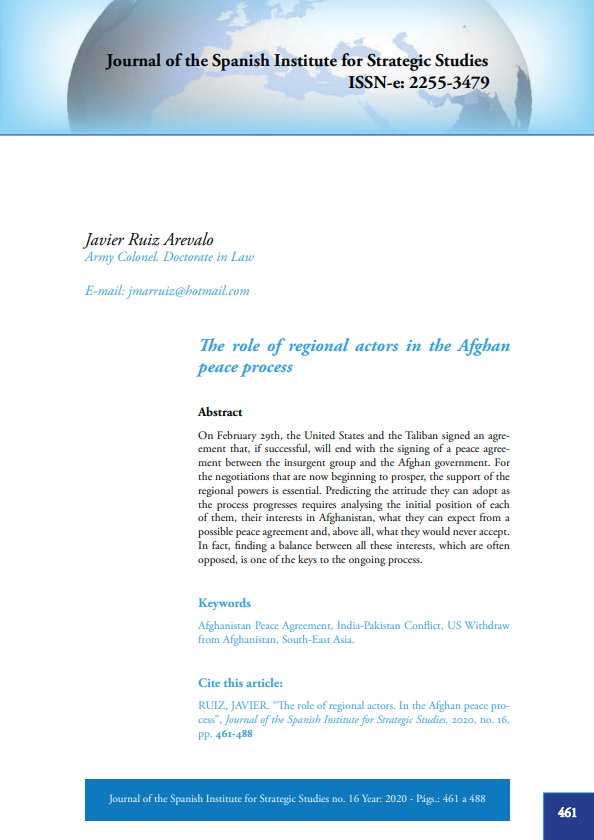
REGIONAL ACTORS' ROLE IN THE AFGHAN PEACE PROCESS
Keywords:
Afghanistan Peace Agreement, India-Pakistan Conflict, US Withdraw from Afghanistan, South-East Asia.Abstract
On February 29th, the United States and the Taliban signed an agreement that, if successful, will end with the signing of a peace agreement between the insurgent group and the Afghan government. For the negotiations that are now beginning to prosper, the support of the regional powers is essential. Predicting the attitude they can adopt as the process progresses requires analysing the initial position of each of them, their interests in Afghanistan, what they can expect from a possible peace agreement and, above all, what they would never accept. In fact, finding a balance between all these interests, which are often opposed, is one of the keys to the ongoing process.
References
AKBARI, Hayat. «Durand Line Border Dispute Remains Point of Contention for Afghanistan-Pakistan Relations». Globalsecurityreview. 24 de marzo de 2019. https://www.mei.edu/publications/durand-line-british-legacy-plaguing-afghanpakistani-relations. (10/03/2020)
CASTRO TORRES, José Ignacio. «El eterno conflicto afgano: las mismas piezas en diferente posición sobre el tablero» en Panorama geopolítico de los conflictos 2018. Instituto Español de Estudios Estratégicos. http://www.ieee.es/Galerias/fichero/
panoramas/panorama_geopolitico_conflictos_2018.pdf. (02/03/2020)
FARMER, Ben. «China ”building military base in Afghanistan” as increasingly active army grows in influence abroad». En The telegraph. 29 de agosto de 2018. https://www.telegraph.co.uk/news/2018/08/29/china-building-military-baseafghanistan/. (10/03/2020)
Global Witness. «War in the Treasury of the People». Report. Junio de 2016.
GOBIERNO DE CANADÁ. «Afghanistan. The precarious struggle for stability».Highlights from an unclassified workshop of the Canadian Security Intelligence Service (CSIS). Mayo de 2019. https://www.canada.ca/en/security-Intelligenceservice/corporate/publications/afghanistan-the-precarious-struggle-for-stability.
html.
HAMIDZADA, Humayun y PONZIO, Richard. «Central Asia’s Growing Role in Buildin Peeace and Regional Connectivity with Afghanistan». United States Institute for Peace. Special Report. 27 de agosto de 2019. https://www.crisisgroup.
org/asia/south-asia/afghanistan/298-building-afghanistans-fleeting-ceasefire.
HUSSAIN, Kashif. «Why the Taliban Won’t Cut Ties with Iran» en The Diplomat. https://thediplomat.com/2020/02/why-the-taliban-wontcut-ties-with-iran/
International Crisis Group. «Building on Afghanistan’s Fleeting Ceasefire». Asia Report No 298. 19 de julio de 2018
INSTITUTO ESPAÑOL DE ESTUDIOS ESTRATÉGICOS. «Análisis geopolítico
de Afganistán». Documento de Análisis. 12/2011. http://www.ieee.es/Galerias/
fichero/docs_analisis/2011/DIEEEA12_2011AnalisisGeopoliticoAfganistan.pdf.
JACKSON, Ashley. «Life Under the Taliban Shadow Government». ODI, Research reports and studies. Junio de 2018. https://www.odi.org/publications/11144-life-under-taliban-shadow-government. (02/03/2020)
MAZZETTI, Mark and KHAN, Ismail. «From the Afghan Peace Deal, a Weak and Pliable Neighbor for Pakistan» en The New York Times. 5 de marzo de 2020. https://www.nytimes.com/2020/03/05/world/asia/afghanistan-pakistan-peace.
NADER Alireza et al. «Iran’s Influence in Afghanistan: Implications for the U.S. Drawdown». Rand Corporation. 2014. https://www.rand.org/content/dam/rand/pubs/research_reports/RR600/RR616/RAND_RR616.pdf.
RAMANI, Samuel. «Can Turkey position itself as the most effective mediator in
Afghanistan?». TRT World. 13 de marzo de 2018. https://www.trtworld.com/
opinion/can-turkey-position-itself-as-the-most-effective-mediator-in-afghanistan--15883 (13/03/2020)
RAMANI, Samuel. «Managed Instability: Iran, the Taliban, and Afghanistan» en
The Diplomat. 14 de noviembre de 2018. https://thediplomat.com/2018/11/managed-instability-iran-the-taliban-and-afghanistan/
RAMANI, Samuel. «In the Demise of the Taliban Peace Talks, Russia Is the Winner». Foreign Policy. 11 de septiembre de 2019. https://foreignpolicy.com/2019/09/11/in-the-demise-of-the-taliban-peace-talks-russia-is-the-winner/.
RASHID, Ahmed. «Pakistan on the Brink. The Future of America. Pakistan and Afghanistan» en Viking. 2012.
RUBIN, Barnett. «Is Afghanistan Ready for Peace? How Great Powers Can End the
War». Foreign Affairs. 30 de julio de 2018. https://www.foreignaffairs.com/articles/afghanistan/2018-07-30/afghanistan-ready-peace. (02/03/2020)
RUIZ ARÉVALO, Javier. «Afganistán. Claves para Entender el Pasado. Pistas para ntuir el Futuro». Universidad de Granada. 2014.
RUIZ ARÉVALO, Javier. «Afganistán y la Red de Distribución Norte. Algo más que un Problema Logístico». Boletín de Información del CESEDEN. n.º 319. Agosto de 2011. https://publicaciones.defensa.gob.es/media/downloadable/files/links/b/o/boletin_ceseden_319.pdf.
RUIZ ARÉVALO, Javier. «Lecciones aprendidas en escenarios complejos ¿Es posible aprender de las operaciones de estabilización?. Instituto Español de Estudios Estratégicos. Documento de opinión 41/2017. Abril de 2017. http://www.ieee.
es/Galerias/fichero/docs_opinion/2017/DIEEEO41-2017_LeccionesAprendidas_RuizArevalo.pdf.
RUIZ AREVALO, Javier. «Conversaciones de paz sobre Afganistán ¿Una última oportunidad para la paz?» en Revista Española de Estudios Internacionales, vol. 5 n.º 2 (2019). http://www.seguridadinternacional.es/revista/?q=content/conversaciones-de-paz-sobre-afganistán-¿una-última-oportunidad-para-la-paz.
RUIZ ARÉVALO, Javier. «El reinicio de las conversaciones de Estados Unidos con los Talibán». Global Strategy. Marzo de 2020. https://global-strategy.org/el-reinicio-de-las-conversaciones-de-estados-unidos-con-los-taliban/ (14/03/2020)
SAJJAD, Ahmed. «The Exclusion of the Taliban from Afghanistan’s State-Building
and Its Human Security Vulnerabilities», International Academic Forum Journal of Politics, Economics & Law, Vol. 4, Issue 1. Primavera de 2017. https://www.researchgate.net/publication/317266013_The_Exclusion_of_the_Taliban_
from_Afghanistan’s_State-Building_and_Its_Human_Security_Vulnerabilities/link/59770306aca2728d027459bb/download.
THIER, J. Alexander «Afghanistan’s Rocky Path to Peace». Current History. Abril de 2010.
United Nations Office on Drugs and Crime. «Afghanistan opium survey 2017». Mayo
WALLDAN, Matt y WRIGHT, Matthew. «Who Wants What Mapping the Parties’ Interests in the Afghanistan Conflict». Research Paper. Asia Programme. Julio de 2014. https://www.chathamhouse.org/sites/default/files/field/field_document/20140731AfghanistanWhoWantsWhat.pdf. (03/03/2020
Downloads
Published
Issue
Section
License
Se permite y anima a los autores a difundir sus trabajos electrónicamente (por ejemplo, en repositorios institucionales o en su propio sitio web) después de la publicación de la revista, para favorecer intercambios productivos, así como una citación más temprana y mayor de los trabajos publicados (Véase The Effect of Open Access).


