
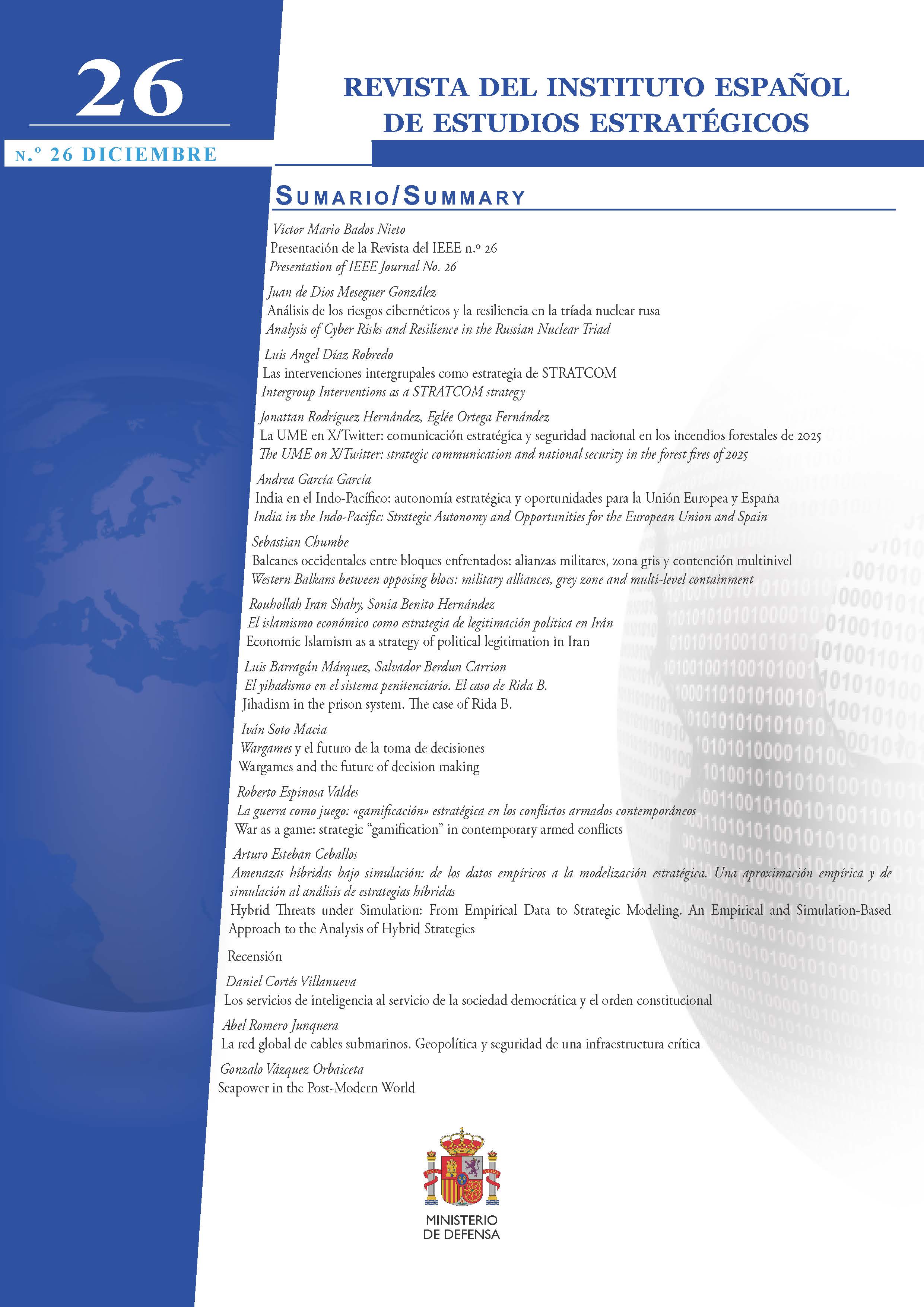
La guerra como juego: «gamificación» estratégica en los conflictos armados contemporáneos
Palabras clave:
Propaganda digital, Yihadismo, Crimen organizado, Videojuegos, UcraniaResumen
Este artículo analiza cómo diversos actores armados implementan lógicas propias de los videojuegos —«gamificación»— en conflictos armados actuales. Mediante un diseño metodológico comparativo de estudios de caso (la guerra ruso‑ucraniana, el extremismo yihadista y el crimen organizado latinoamericano), se aplica una rúbrica de indicadores operativa para evaluar el grado de formalización de estas prácticas. Se identifican las formas, funciones y objetivos estratégicos de la «gamificación» y se evalúan sus efectos operativos, psicológicos y comunicativos sobre combatientes y audiencias civiles. Los resultados demuestran que la «gamificación» actúa como un multiplicador estratégico, potenciando la propaganda y el reclutamiento. Se observa que cada caso presenta un nivel distinto (estructurada en Ucrania, simbólica en el yihadismo e informal en el crimen organizado) y que estas dinámicas contribuyen a transnacionalizar las narrativas de guerra, trivializando la violencia y atrayendo, especialmente, a públicos jóvenes.
Referencias
Allenby, B. y Garreau, J. (2017). Weaponized Narrative: The New Battlespace [en línea]. Center on the Future of War. [Consulta: 2026]. Disponible en: https://www.defenseone.com/ideas/2017/01/weaponized-narrative-new-battlespace/134284/
Andrews, S. (2023). First-person propaganda, first-person shooters: A different view [en línea]. GNET Research. [Consulta: 2026]. Disponible en: https://gnet-research.org/2023/06/01/first-person-propaganda-first-person-shooters-and-gamification-a-different-view/
Bachmann, S., y Gunneriusson, H. (2015). Hybrid wars: The 21st-century’s new threats to global peace and security [en línea]. Scientia Militaria. 43(1), pp. 77-98. [Consulta: 2026]. Disponible en: https://doi.org/10.5787/43-1-1110
Bondar, K. (2024). Does Ukraine already have functional CJADC2 technology? [en línea]. Center for Strategic and International Studies (CSIS). [Consulta: 2026]. Disponible en: https://www.csis.org/analysis/does-ukraine-already-have-functional-cjadc2-technology
Bonello, D. (2022). 15-year-old girl kills herself with an Uzi trying to record a TikTok video [en línea]. Vice. [Consulta: 2026]. Disponible en: https://www.vice.com/en/article/mexico-sinaloa-girl-uzi-tiktok
Brave1. (2025). Army of Drones: Bonus – Digital reward program [en línea]. Brave1 Platform. [Consulta: 2026]. Disponible en: https://brave1.gov.ua/en/
Carrillo, L. (2021). How TikTok shows untold truths of communities linked to drug trafficking [en línea]. InSight Crime. [Consulta: 2026]. Disponible en: https://insightcrime.org/news/how-tiktok-shows-untold-truths-of-communities-linked-to-drug-trafficking/
Dauber, C. et al. (2019). Call of Duty: Jihad – How the video game motif has migrated downstream from Islamic State propaganda videos [en línea]. Perspectives on Terrorism. 13(3), pp. 17-31. [Consulta: 2026]. Disponible en: https://pt.icct.nl/sites/default/files/2023-06/02--dauber-et-al..pdf
Deci, E. L. y Ryan, R. M. (2000). The “what” and “why” of goal pursuits: Human needs and the self-determination of behavior [en línea]. Psychological Inquiry. 11(4), pp. 227-268. [Consulta: 2026]. Disponible en: https://doi.org/10.1207/S15327965PLI1104_01
Deterding, S. et al. (2011). From game design elements to gamefulness: Defining “gamification”. En: Proceedings of the 15th International Academic MindTrek Conference. ACM. Pp. 9-15). [Consulta: 2026]. Disponible en: https://doi.org/10.1145/2181037.2181040
Frasca, G. (2007). Play the message: Play, game and videogame rhetoric [tesis doctoral]. IT University of Copenhagen.
Hassan, L. y Hamari, J. (2020). Gameful civic engagement: A review of the literature on gamification of e-participation [en línea]. Government Information Quarterly. 37(3). [Consulta: 2026]. Disponible en: https://doi.org/10.1016/j.giq.2020.101461
Huizinga, J. (2000). Homo ludens. Alianza Editorial.
Hunt, E. (2016). Islamic State releases children’s mobile app ‘to teach Arabic’ [en línea]. The Guardian. [Consulta: 2026]. Disponible en: https://www.theguardian.com/world/2016/may/11/islamic-state-children-app-mobile-teach-arabic
Huotari, K. y Hamari, J. (2012). Defining gamification – A service marketing perspective [en línea]. En: Proceedings of the 16th International Academic MindTrek Conference. ACM. Pp. 17-22). [Consulta: 2026]. Disponible en: https://doi.org/10.1145/2393132.2393137
Kabachynskyi, I. (2025). How Ukraine turned a point-based rewards system into an effective model for war management [en línea]. UNITED24 Media. [Consulta: 2026]. Disponible en: https://united24media.com/war-in-ukraine/ukraines-newpoint-based-rewards-system-for-drone-operators-is-rewriting-war-management-from-the-ground-up-8528
Lakhani, S.; White, J. y Wallner, C. (2022). The gamification of (violent) extremism [en línea]. Radicalisation Awareness Network (RAN), European Commission. [Consulta: 2026]. Disponible en: https://home-affairs.ec.europa.eu/system/files/2022-09/RAN%20Policy%20Support-%20gamification%20of%20violent%20extremism_en.pdf
Lethal Crysis. (2025). Drone pilots: Ukraine #04 [Video] [en línea]. YouTube. [Consulta: 2026]. Disponible en: https://www.youtube.com/watch?v=JRzJUhvqDR8
Marchini, C. S. (2023). The digital drug revolution: How online markets are reshaping global illicit trade [en línea]. Global Initiative Against Transnational Organized Crime. [Consulta: 2026]. Disponible en: https://globalinitiative.net/analysis/digital-drug-revolution-online-markets-global-illicit-trade-ocindex/
Marson, J. (2024). The nerdy gamers who became Ukraine’s deadliest drone pilots [en línea]. The Wall Street Journal. [Consulta: 2026]. Disponible en: https://www.wsj.com/world/europe/ukraine-gamers-drone-pilots-russia-85a1af3b
Michael, D. y Chen, S. (2006). Serious games: Games that educate, train, and inform. Thomson.
NATO StratCom COE. (2021). Information Influence1 as a Tool of Hybrid Threats [en línea]. NATO Strategic Communications Centre of Excellence. [Consulta: 2026]. Disponible en: https://stratcomcoe.org/uploads/NATO_StratCom_COE_brief.pdf
O’Carroll, L. (2023). Meet Diia: the Ukrainian app used to do taxes … and report Russian soldiers [en línea]. The Guardian. [Consulta: 2026]. Disponible en: https://www.theguardian.com/world/2023/may/26/meet-diia-the-ukrainian-app-used-to-do-taxes-and-report-russian-soldiers
Pötzsch, H. (2015). The emergence of iWar: Changing practices and perceptions of military engagement in a digital era [en línea]. New Media & Society. 17(1), pp. 78-95. [Consulta: 2026]. Disponible en: https://doi.org/10.1177/1461444813516834
Pokotylo, O. (2025). Auterion to supply Ukraine with tens of thousands of AI drone strike kits [en línea]. The Defender. [Consulta: 2026]. Disponible en: https://thedefender.media/en/2025/07/auterion-to-provide-thousands-aidrones/
Prucha, N. (2016). IS and the jihadist information highway – Projecting influence and religious identity via Telegram [en línea]. Perspectives on Terrorism. 10(6). [Consulta: 2026]. Disponible en: https://pt.icct.nl/article/and-jihadist-information-highway-projecting-influence-and-religious-identity-telegram
Quevedo Delgado, S. V. (2025). Plata, armas, coca y mujeres: los ‘anzuelos’ para el reclutamiento de menores de edad en TikTok y Facebook [en línea]. El
Tiempo. [Consulta: 2026]. Disponible en: https://www.eltiempo.com/justicia/paz-y-derechos-humanos/plata-armas-coca-y-mujeres-los-anzuelos-para-el-reclutamiento-de-menores-de-edad-en-tik-tok-y-facebook-3448154
Shevko, D. (2025). Ukraine’s drone war gets gamified: Why ‘Bonus points for kills’ is more than a morale booster [en línea]. New Voice of Ukraine. [Consulta: 2026]. Disponible en: https://english.nv.ua/opinion/ukraine-gamifies-war-with-drone-kill-points-in-army-of-drones-bonus-program-50520526.html
Sicart, M. (2014). Play matters [en línea]. MIT Press. [Consulta: 2026]. Disponible en: https://mitpress.mit.edu/9780262534512/play-matters/
Skinner, B. F. (1953). Science and human behavior. The Macmillan Company.
The Economist. (2025). How drones and video-game techniques are coming together in Ukraine’s war [en línea]. The Economist. [Consulta: 2026]. Disponible en: https://www.economist.com/the-economist-explains/2025/07/08/how-drones-and-video-game-techniques-are-coming-together-in-ukraines-war
Weimann, G. (2015). Terrorist migration to social media [en línea]. Georgetown Journal of International Affairs. 16(1), pp. 180-187. [Consulta: 2026]. Disponible en: https://archive-yaleglobal.yale.edu/terrorism-cyberspace-next-generation
Werbach, K. y Hunter, D. (2012). For the win: How game thinking can revolutionize your business. Wharton Digital Press.
Winkler, C. K. y Dauber, C. E. (eds.). (2014). Propaganda visual y extremismo en el entorno digital [en línea]. U.S. Army War College Press. [Consulta: 2026]. Disponible en: https://press.armywarcollege.edu/monographs/946/
Winter, C. (2015). Documenting the virtual ‘caliphate’ [en línea]. Quilliam Foundation. [Consulta: 2026]. Disponible en: https://voxpol.eu/file/documenting-the-virtual-caliphate/
Descargas
Publicado
Número
Sección
Licencia

Esta obra está bajo una licencia internacional Creative Commons Atribución-NoComercial-SinDerivadas 4.0.
Se permite y anima a los autores a difundir sus trabajos electrónicamente (por ejemplo, en repositorios institucionales o en su propio sitio web) después de la publicación de la revista, para favorecer intercambios productivos, así como una citación más temprana y mayor de los trabajos publicados (Véase The Effect of Open Access).


