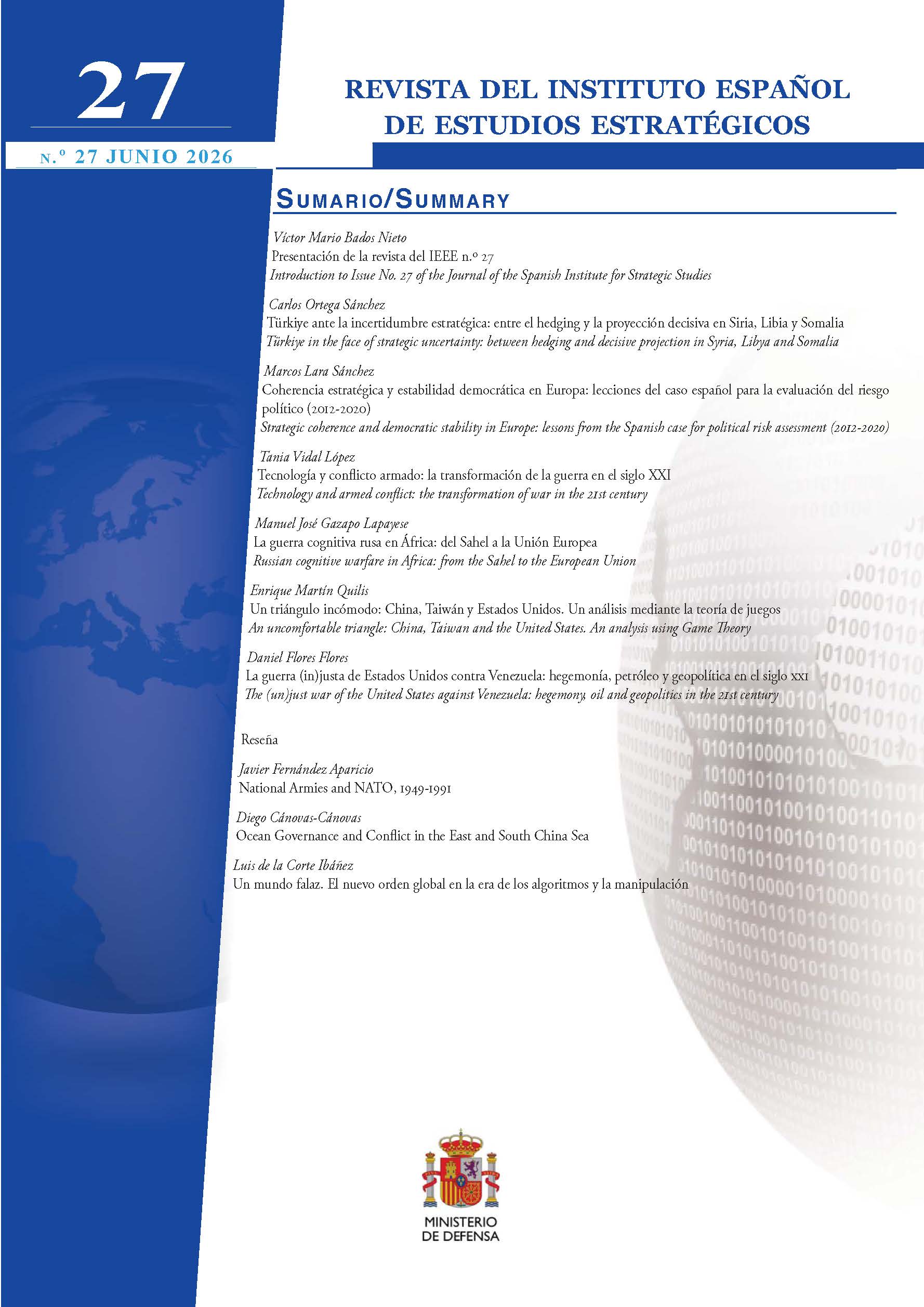
Un triángulo incómodo: China, Taiwán y Estados Unidos. Un análisis mediante la Teoría de los Juegos
Keywords:
Geopolitics, International economy, Strategic interaction, Military conflict, Security.Abstract
This paper examines the relationship between China and the United States regarding Taiwan's status using Game Theory. A sequential model is proposed in which China and Taiwan interact first, followed by Taiwan and the United States, in both cases in a two-person game with complete information. The third stage validates the first game, with the outcome of the second game conditioning this validation. Both Taiwan and the United States structure their preferences using two distinct "temperaments": conciliatory or nationalist for the former, and moderate (dovish) or belligerent (hawkish) for the latter. Technically, the analysis focuses on determining the Nash equilibria of each game, refined with the Non-Myopic Equilibria (NME) from the Theory of Moves (Brams, 1994). This theory introduces a dynamic dimension to the analysis, allowing for a distinction between short-term and long-term solutions. Furthermore, special attention is paid to problems of asymmetric information.
Downloads
References
Allison, G. (2015). The Thucydides Trap: Are the U.S. and China Headed for War?. The Atlantic.
Benson, B. y Niou, E. M. S. (2000). Comprehending Strategic Ambiguity: US Policy Toward the Taiwan Strait Security Issue. Working Paper. Duke University, Department of Political Science.
Bonnano, G. (2018). Game Theory. CreateSpace Independent Publishing Platform.
Brams, S. J. (1993) Theory of Moves. American Scientist. 84(6), pp. 562-570.
—. (1994). Theory of Moves. Cambridge University Press.
—. (2001). Game Theory and the Cuban Missile Crisis [en línea]. Plus.maths.org. [Consulta: 9 abril 2026]. Disponible en: https://plus.maths.org/game-theory-and-cuban-missile-crisis
Cancian, M. F., Cancian, M. y Heginbotham, E. (2023). The First Battle of the Next War. Wargaming a Chinese Invasion of Taiwan. Center for Strategic and International Studies (CSIS).
—. (2025). Wargaming a Chinese Blockade of Taiwan. Center for Strategic and International Studies (CSIS).
Castelltort Claramunt, M. (2021). El posible conflicto bélico entre Estados Unidos y China: reconsiderando la «Trampa de Tucídides». Revista del Instituto Español de Estudios Estratégicos. 17, pp. 271–300.
Chang, J. J. (2000). Lessons from the Taiwan Relations Act. Orbis. Winter Issue, pp. 63-77.
Chang, C. H. (2007). A Game Theory View of the Relationship between the U.S., China and Taiwan. U.S. Naval Postgraduate School, MBA Professional Report.
Cliff, R. y Shlapak, D. A. (2007). U.S.–China Relations after Resolution of Taiwan’s Status. RAND Corporation, Project Air Force.
CSIS (2026). Taiwan ADIZ Violations [en línea]. China Power. Center for Strategic and International Studies (CSIS). [Consulta: 13 abril 2026]. Disponible en: https://chinapower.csis.org/data/taiwan-adiz-violations/
Ericson, R. E. y Zeager, L. A. (2015). Ukraine Crisis 2014: A Study of Russian- Western Strategic Interaction. Peace Economics, Peace Science and Public Policy. 21(2), pp. 153–190.
Feldman, H. (2007). President Reagan’s Six Assurances to Taiwan and Their Meaning Today. WebMemo no. 1653. The Heritage Foundation.
Franck, R. E. y Melese, F. (2003). A Game Theory View of Military Conflict in the Taiwan Strait. Defense and Security Analysis. 19(4), pp. 327-348.
Gates, S. y Humes, B. D. (1997). Games, Information, and Politics: Applying Game Theoretic Models to Political Science. University of Michigan Press.
Gilboa, I. (1995). Review of Theory of Moves. Games and Economic Behavior. 10(2), pp. 368–372.
Herrero Martínez, M. (2025). Dos Estados, una misma cultura. Documento de Opinión, Instituto Español de Estudios Estratégicos, 87/2025.
Kan, S. A. y Morrison, W. M. (2014). U.S.-Taiwan Relationship: Overview of Policy Issues. Congressional Research Service, CSR Report 7-5700.
Kuntić, D. (2015). The Ominous Triangle: China-Taiwan-the United States relationship. Croatian International Relations Review. 21(72), pp. 239-280.
Lin, T. (2021). Peace in the Taiwan Strait: The Triangular Relationship among the United States, Taiwan, and China [Tesis Doctoral]. Johns Hopkins University.
Martin, B. et al. (2022). Implications of a Coercive Quarantine of Taiwan by the People's Republic of China. RAND Corporation.
Mazarr, M. J.; Kerrigan, A. y Lenain, B. (2025). Stabilizing the U.S.-China Rivalry.
RAND Corporation.
Mearsheimer, J. J. (2014). Say Goodbye to Taiwan. The National Interest.
Melián Negrín, M. Á. (2024). Realismo, Estados Unidos y China: comparativa y proyección estratégica en el océano Pacífico. Revista del Instituto Español de Estudios Estratégicos. 24, pp. 65-96.
Morrow, J. D. (1994). Game Theory for Political Scientists. Princeton University Press.
Niou, E. M. S. (2004) Understanding Taiwan Independence and its Policy Implications. Asian Survey. 44(4), pp. 555-567.
O’Hanlon, M. E. (2022). Can China take Taiwan? Why no one really knows. Foreign Policy at Brookings. Brookings Institution.
Pérez Expósito, F. L. (2023). El conflicto en el estrecho de Taiwán: situación y perspectivas. Boletín del Instituto Español de Estudios Estratégicos. 32, pp. 324-360.
Quilis, E. M. (2017). Theory of Moves (ToM) Calculator. MATLAB Central File Exchange.
Schelling, T. C. (1960). The Strategy of Conflict. Harvard University Press.
Scobell, A.et al. (2020). China's Grand Strategy. Trends, Trajectories, and Long-Term Competition. RAND Corporation.
Scobell, A. et al. (2025). The 2022 Pelosi Visit to Taiwan: Assessing US-China Signaling and Action-Reaction Dynamics. United States Institute of Peace, Special Report.
Snidal, D. (1985). The Game Theory of International Politics. World Politics. 38(1), pp. 25-57.
Stone, R. W. (2001). The Use and Abuse of Game Theory in International Relations. The Theory of Moves. Journal of Conflict Resolution, 45(2), pp. 216-244.
Wang, T. Y. (2025). Strategic Ambiguity or Strategic Clarity: China’s Rise and US Policy Towards the Taiwan Issue. Journal of Asian Security and International Affairs. 12(2), pp. 221–240.
Willson, S.J. (1998). Long-Term Behavior in the Theory of Moves. Theory and Decision. 45(3), pp. 201–240.
Wolfenstein, K. (2025) Relaciones económicas entre China y Taiwán: una paradoja de interdependencia a la sombra del conflicto político [en línea]. XPert, Xpert.Digital. [Consulta: 14 abril 2026]. Disponible en: https://xpert.digital/es/relaciones-economicas-entre-china-y-taiwan/
Wolfinger, J. E. (1984). United States-China Relations: Has President Reagan's Communique Revised International Obligations Towards Taiwan?. California Western International Law Journal. 14(2), pp. 326-350.
Wu, C. (2003). Peace or War in the Taiwan Strait [Tesis Doctoral]. Virginia Polytechnic Institute.
Xi, J. (2022). Informe presentado ante el XX Congreso Nacional del Partido Comunista de China.
Zagare, F. C. (2014). A Game-Theoretic History of the Cuban Missile Crisis.
Economies. 2(1), pp. 20-44.
Zietek, A.; Larus, E. F. y Tatarczak, A. (2025). The Taiwan Game. Navigating U.S.–China Tensions from Game Theory Perspective. Stosunki Międzynarodowe–International Relations. pp. 5-14.
Downloads
Published
Issue
Section
License

This work is licensed under a Creative Commons Attribution-NonCommercial-NoDerivatives 4.0 International License.
Se permite y anima a los autores a difundir sus trabajos electrónicamente (por ejemplo, en repositorios institucionales o en su propio sitio web) después de la publicación de la revista, para favorecer intercambios productivos, así como una citación más temprana y mayor de los trabajos publicados (Véase The Effect of Open Access).


